
Takhti Wrestling Cup Medals
Commemorative Design between Representation and Production
October 2014
Bronze, Electroplated in gold, rhodium, and copper finishes
The Question
How can a commemorative medal balance historical representation, manufacturability, and material quality in large-scale production?
In 2014, I was commissioned by the Iranian Wrestling Federation to design and produce the official medals for the Takhti Wrestling Cup, an international tournament held in memory of Gholamreza Takhti. The project required the complete development of the medal, from digital modelling to final production, while preserving both technical quality and the symbolic identity of the event.
Searching for Form
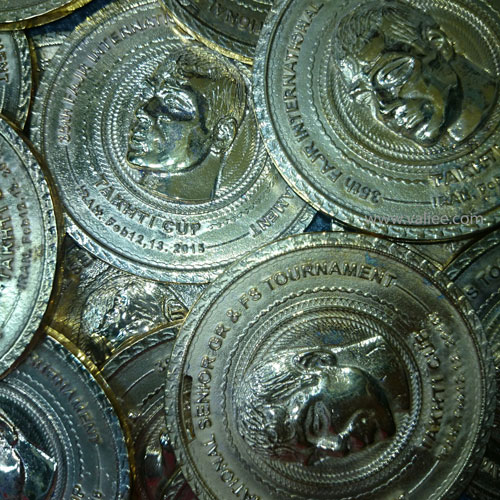
The primary challenge was translating Takhti’s portrait into a relief that could remain visually clear after mould making, casting, finishing, and electroplating. The design process included digital sculpting in ZBrush, prototype evaluation, CNC master production, mould preparation, wax reproduction, casting, finishing, and multiple electroplating tests.
At the beginning of the project, industrial coin-minting was proposed for higher dimensional accuracy. After discussions with the client, the decision shifted toward lost-wax casting to achieve a more handcrafted character and an aged surface quality that better reflected the historical atmosphere of the event.
Material Translation
Bronze medals were produced and electroplated in three finishes. The work examined how relief depth, surface quality, and production decisions shape both the symbolic presence of a commemorative object and its technical performance at scale.
Reflection
This project investigated the tension between representation, material constraint, and production method. It demonstrated how design decisions in commemorative metalwork are shaped not only by image and symbolism, but also by manufacturing realities and the desired material character of the final object.
Documentation
The project is documented through digital relief modelling, CNC masters, wax replicas, electroplating tests, and the final produced medals.