A Translation of Movement, Language, and Meaning into Form
May 2021 18k Gold
The Question
How can movement, language, and philosophical meaning be translated into a wearable object without becoming mere illustration?
This project began with a commission inspired by Sama — a Sufi ritual of whirling meditation rooted in Islamic mysticism, in which repetitive circular movement becomes a form of spiritual practice and devotion. Rather than representing the dance itself or illustrating a whirling figure, I became interested in how its underlying philosophy — movement as transformation, rhythm as meaning, and the body as a vessel — could be translated into a wearable object.
The central question was whether jewellery could hold philosophical content not through literal depiction, but through form, rhythm, and material presence.
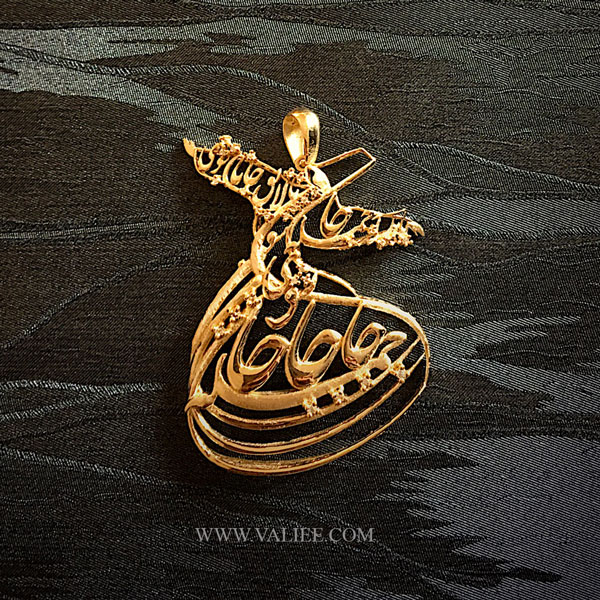
Completed 18k gold pendant — the calligraphic form translated into wearable structure, carrying rhythm and movement through material presence.
Searching for Form
The conceptual direction of the piece emerged through conversations with a mentor who is both a scholar and a practitioner of Sama. During these discussions, I encountered a verse by Rumi:
“One must become entirely soul to become worthy of the Beloved.”
Instead of using the poem as a decorative inscription placed onto the surface of an object, I focused on the repeated presence of the word Jan (Soul). The rhythm and recurrence of this word became the structural and visual foundation of the design.
The calligraphic composition was developed to evoke movement. Rather than remaining a static quotation, the form was shaped so that rhythm could emerge through structure itself — suggesting rotation, continuity, and an inward turning.
Digital translation of the calligraphic composition into three-dimensional jewellery form.
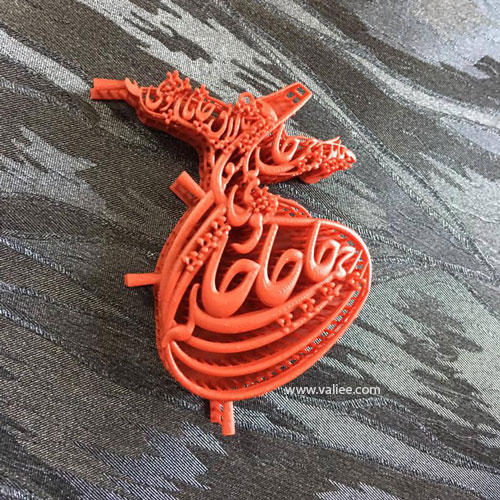
Resin prototype used to test scale, rhythm, and movement before final production in gold.
Material Translation
Through digital modelling, the calligraphic rhythm was translated into a three-dimensional jewellery structure. A resin prototype was made to test scale, balance, proportion, and the sense of movement within the form before committing to the final material.
The finished pendant was realised in 18k gold. The choice of gold carried both technical and symbolic weight: a material traditionally associated with permanence and value, here used to hold a form concerned with transformation and spiritual becoming.
Rather than depicting a whirling dancer, the piece attempts to materialise the experience of rotation itself. Philosophical meaning is carried through rhythm, proportion, and the physical presence of the object on the body.
Hand-finishing the gold pendant: adjusting and refining the calligraphic form after casting.
Final detailing and polishing of the gold pendant, refining surface and form before completion.
Reflection
This project investigated how jewellery can function as a site of translation — between language and form, movement and stillness, philosophy and material.
The pendant does not illustrate Sama. It attempts to carry something of its internal logic: the idea that meaning can be embodied through repetition, rhythm, and form rather than through representation alone. In this sense, the work continues my broader inquiry into how contemporary jewellery can hold narrative, embodied experience, and conceptual meaning within a wearable object.
Detail of the finished gold pendant, revealing the layered calligraphic structure and material depth.
Documentation
The project is documented through calligraphic studies, digital form development, resin prototyping, and the final realisation in gold. Together, these stages trace the movement from poetic language to material structure, and from conceptual inquiry to a wearable object.