
This question is no longer speculative—it has become urgent. It is frequently raised by students, emerging practitioners, and seasoned colleagues as generative algorithms and procedural tools rapidly enter the CAD workflow. As an educator and practitioner whose work spans advanced digital 3D fabrication yet remains deeply rooted in the physical studio—where hands spent years working with gold dust, wax, and metal—the answer is clear:
AI is not a replacement. It is a fundamental shift in the medium.

The intersection of tactile mastery and algorithmic potential.
True digital craftsmanship doesn’t replace the bench—it extends it. Hands shaped by years of working with wax, metal,
and gold dust bring irreplaceable material intuition to advanced CAD modeling and generative tools.
1. The Real Bottleneck: Generative Speed vs. Structural Reality
Generative AI text-to-3D and image-to-3D models excel at producing visual novelties in seconds. However, there is a substantial void between an aesthetically compelling render and a manufacturable piece of fine jewelry.
AI lacks physical spatial awareness. It does not understand casting shrinkage, metal tolerances, sprue placements, stone seat clearances, or ergonomic weight distribution against the body. The primary challenge in digital jewelry design has rarely been generating raw visual ideas; it is translating abstract concepts into production-ready geometries that survive SLA 3D printing, investment casting, and setting.
2. Comparative Workflow: AI Automation vs. Human Mastery
To understand where the designer retains absolute agency, we must examine how the workflow divides between machine velocity and human expertise:
| Design & Production Phase | AI Capabilities | Human Designer Expertise |
| Ideation & Concepting | Generates dozens of visual concepts and variations in minutes. | Critical Curation: Selecting viable forms and eliminating unbuildable geometry. |
| 3D Modeling (CAD) | Auto-generates complex parametric patterns and mesh topologies. | Creative Engineering: Structuring wall thicknesses, prongs, and stone seats for physical assembly. |
| Client Consultation | Provides instant photorealistic renders to explore aesthetic directions. | Empathetic Dialogue: Interpreting emotional narratives and sentimental heirloom values. |
| Physical Fabrication | N/A (Limited to digital asset generation). | Tacit Craftsmanship: Hands-on material handling, wax carving, metal flow control, and setting. |

AI vs. Human Mastery in Jewelry Design: Speed vs. Substance.
While algorithms excel at rapid iteration, complex patterns, and instant renders, they lack spatial material awareness, tacit knowledge,
and the ability to interpret emotional heirloom value.
3. The Irreplaceability of Tacit Material Knowledge
AI models are trained on scraped digital data—pixels, vectors, and text descriptions. However, tacit knowledge cannot be scraped, trained, or generated; it is produced exclusively through physical practice.
Decades of hands-on goldsmithing cultivate an intuitive material literacy:
- Knowing how molten metal flows under heat.
- Feeling how carving wax responds to tool pressure.
- Anticipating how light reflects across a hand-polished bevel versus a flat digital polygon.
- Making tactile judgments about whether a prong will securely hold an heirloom gem across decades of daily wear.
This physical intuition directly informs how a designer operates digital CAD software like Rhinoceros or MatrixGold. Without tacit material understanding, digital design risks producing frail, uncomfortable, or unmanufacturable artifacts.
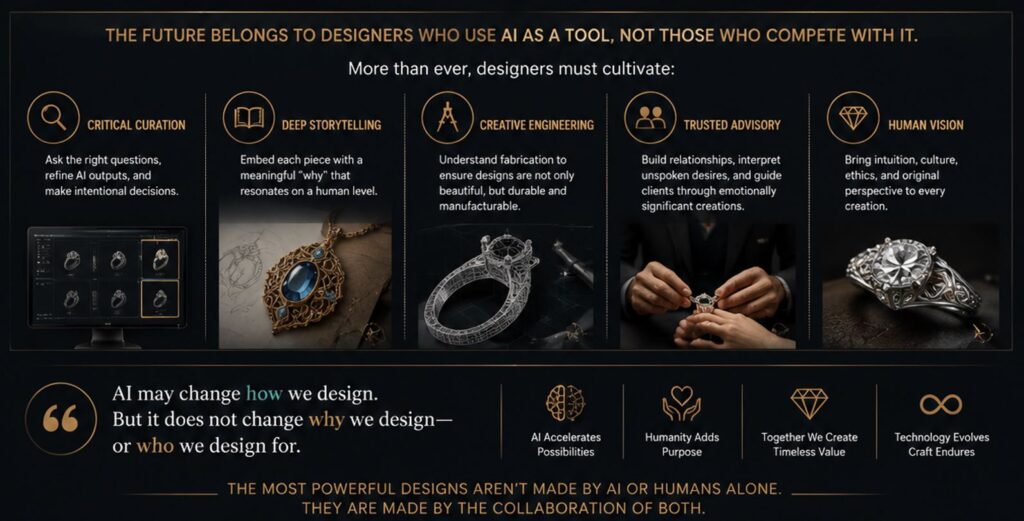
The Future of Digital Craftsmanship is Hybrid.
The future doesn’t belong to those who compete with AI, but to designers who use it as an intelligent studio partner. Cultivating critical
curation, deep storytelling, creative engineering, and trusted advisory will define the next generation of jewelry designers.
4. Cultivating the Hybrid Designer: Four Essential Capacities
The future belongs to designers who leverage AI as an intelligent studio partner rather than competing against its computational speed. To thrive in an AI-augmented ecosystem, digital jewelry designers and educators must focus on four core pillars:
- Critical Curation: Moving beyond prompt generation to evaluate structural viability, material ethics, and aesthetic coherence.
- Deep Storytelling: Embedding each creation with a clear conceptual purpose that connects meaningfully with the wearer.
- Creative Engineering: Bridging the gap between digital generative meshes and real-world fabrication constraints.
- Trusted Advisory: Building genuine human relationships, interpreting unspoken client desires, and guiding emotionally significant commissions.
Conclusion: Why We Design Endures
AI will undeniably transform how we design and iterate. But it cannot alter why we design—or the intimate, human connections that give jewelry its enduring value.
The most powerful artifacts of the future will not be produced by AI alone, nor by human hands working in isolation. They will emerge from the thoughtful collaboration of both: leveraging computational possibilities while preserving the irreplaceable soul of human craft